My personal letter to you Dear citizen, Please take my Salam. I am writing this letter to you with the hope of receiving a personal reply from you. You might have noticed in what situation many people requested me to join politics and why I had to consider it with utmost importance. I, like you, witnessed where our political culture has brought the country and how it attempted to destroy the country's future possibilities. The way the present caretaker government is trying to create an acceptable atmosphere by carrying out necessary reforms has made me optimistic along with all citizens of the country.
In this situation, I feel it with my heart that I should, showing due respect to the people's expectation of me, participate in the mission of taking the nation to the height it deserves.
It is now clear to all that it is not possible to reach the goal maintaining the existing political culture; it is only possible by bringing a comprehensive change to the culture. Through my work and experience, I feel with all my heart that the people with their innate sense of endeavour and creativity can achieve the impossible if political goodwill, competent leadership and good governance can be established. If I have to form a political party in response to the people's desire, it will be dedicated to this very objective. I have received pure love and respect from people of all ages ranging from the poorest to the most powerful, I do not know when again a Bangladeshi individual will have this good fortune. By the grace of Allah, I am a very fortunate man. There is nothing left for me to desire. I know that joining politics is to become controversial. I am ready to take the risk if you think me joining politics will help in ushering of a new political climate.
It is high time to form the proper political structure conducive to the huge task of building a Bangladesh we all dream of, by freeing ourselves from all past frustrations. I need the active participation and assistance of you and all others like you if I have to go forward with this mission. I need your advice on how I should go forward. I also want to know how you want to participate and assist in this task. The efforts of you and me to realise everybody's desire for a new politics in order to build a new Bangladesh will get strength if these can be learnt from you in the form of a letter.
You can give your advice in your own style on any topic regarding the formation of a new political party. I can point out some topics as examples: a) how the party can stay involved with the people of all villages and neighbourhoods and work to realise their expectations; b) how the party can be helpful to the common people in their daily struggle and in solving their problems; c) how the organisations of the party can be built on the basis of spontaneous devotion of men and women of all ages and professions; d) what can be done to encourage the eager, enthusiastic, honest and competent people of all levels to align with the party and to become active in it; e) how the honest and competent among them, having public support, can be nominated for different local and national elections; f) how can we ensure transparency and honesty of all the people involved with the party, and of the party itself; g) how democracy can be established within the party; h) how can the flow of opinions directly from the grassroots level be ensured; and i) how the officials and employees serving in state institutions can be prevented from turning into activists of political parties -- your thoughts and advice on many such questions are vital.
At the same time, it is important to know what role you (and your friends) can play in the party, how you can actively contribute or support, is also very important to know. For example, you can play the role: a) of a member of a village or neighbourhood-level organisation; b) of a pioneer of the party's welfare initiatives; c) of a local organiser; d) of an organiser of a community organisation; e) of an activist taking party calls widely among the people; f) of an adviserresearchertheoretician for the party; g) you can contribute to the party by using your special skills or expert knowledge in its service; h) by taking a leadership role in popularising the party as an enthusiastic supporter; i) by demonstrating your organising power; and so on.
I want to know your opinion and get your advice whether you are a political leader, activist, leader or worker of an association or organisation, industrialist, businessman, professor, teacher, shopkeeper, farmer, labourer, artist-writer-thinker, professional, journalist, service holder, housewife, teenager, youth or an expatriate Bangladeshi.
Please write a short or detail personal reply to my letter. Your friends, all members of your family, neighbours, classmates and colleagues can also put in their thoughts in the same letter. You can reply through email and distribute copies of it among all your acquaintances. You can also send a short reply through SMS and encourage all your acquaintances to do the same. You can send copies of my letter to your relatives and friends abroad and encourage them to reply. It will not be possible to come out clean from old politics if a strong momentum for a new politics is not created. We will not be able to reach our goal with feeble support.
I hope my letter and your reply to it will only be the beginning of our sincere communication. The communication established will be able to go forward actively towards a common goal from now on.
You can use my following address to send your reply or may arrange to send it to me in any other way.
Contact Address:Dr Muhammad YunusHAL Mars6/D, 66 Outer Circular RoadMoghbazar, Dhaka 1217Fax: 9334656Email:
' );
//-->\n
prof.yunus@gmail.com
' );
//-->
This email address is being protected from spam bots, you need Javascript enabled to view it
' );
//-->
,
' );
//-->\n
dryunus2006@yahoo.com
' );
//-->
This email address is being protected from spam bots, you need Javascript enabled to view it
' );
//-->
You can call the following numbers for inquiries about the letter: 01713082277, 01717760870Waiting for your reply.With thanks and greetings,Muhammad YunusFebruary 11, 2007
(Translated from Bangla by The Daily Star)
Wednesday, June 20, 2007

Nobel Prize :: Ceremony Speech
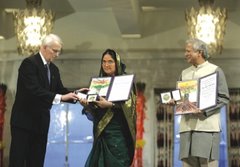
Your Majesties, Your Royal Highnesses, Honorable Members of the Norwegian Nobel Committee, Excellencies, Ladies and Gentlemen.Grameen Bank and I are deeply honoured to receive this most prestigious of awards. We are thrilled and overwhelmed by this honour. Since the Nobel Peace Prize was announced, I have received endless messages from around the world, but what moves me most are the calls I get almost daily, from the borrowers of Grameen Bank in remote Bangladeshi villages, who just want to say how proud they are to have received this recognition.
Nine elected representatives of the 7 million borrowers-cum-owners of Grameen Bank have accompanied me all the way to Oslo to receive the prize. I express thanks on their behalf to the Norwegian Nobel Committee for choosing Grameen Bank for this year's Nobel Peace Prize. By giving their institution the most prestigious prize in the world, you give them unparalleled honour. Thanks to your prize, nine proud women from the villages of Bangladesh are at the ceremony today as Nobel laureates, giving an altogether new meaning to the Nobel Peace Prize.
All borrowers of Grameen Bank are celebrating this day as the greatest day of their lives. They are gathering around the nearest television set in their villages all over Bangladesh , along with other villagers, to watch the proceedings of this ceremony.
This years' prize gives highest honour and dignity to the hundreds of millions of women all around the world who struggle every day to make a living and bring hope for a better life for their children. This is a historic moment for them. Poverty is a Threat to Peace
Ladies and Gentlemen:
By giving us this prize, the Norwegian Nobel Committee has given important support to the proposition that peace is inextricably linked to poverty. Poverty is a threat to peace.
World's income distribution gives a very telling story. Ninety four percent of the world income goes to 40 percent of the population while sixty percent of people live on only 6 per cent of world income. Half of the world population lives on two dollars a day. Over one billion people live on less than a dollar a day. This is no formula for peace.
The new millennium began with a great global dream. World leaders gathered at the United Nations in 2000 and adopted, among others, a historic goal to reduce poverty by half by 2015. Never in human history had such a bold goal been adopted by the entire world in one voice, one that specified time and size. But then came September 11 and the Iraq war, and suddenly the world became derailed from the pursuit of this dream, with the attention of world leaders shifting from the war on poverty to the war on terrorism. Till now over $ 530 billion has been spent on the war in Iraq by the USA alone.
I believe terrorism cannot be won over by military action. Terrorism must be condemned in the strongest language. We must stand solidly against it, and find all the means to end it. We must address the root causes of terrorism to end it for all time to come. I believe that putting resources into improving the lives of the poor people is a better strategy than spending it on guns. Poverty is Denial of All Human Rights
Peace should be understood in a human way − in a broad social, political and economic way. Peace is threatened by unjust economic, social and political order, absence of democracy, environmental degradation and absence of human rights.
Poverty is the absence of all human rights. The frustrations, hostility and anger generated by abject poverty cannot sustain peace in any society. For building stable peace we must find ways to provide opportunities for people to live decent lives.
The creation of opportunities for the majority of people − the poor − is at the heart of the work that we have dedicated ourselves to during the past 30 years. Grameen Bank
I became involved in the poverty issue not as a policymaker or a researcher. I became involved because poverty was all around me, and I could not turn away from it. In 1974, I found it difficult to teach elegant theories of economics in the university classroom, in the backdrop of a terrible famine in Bangladesh. Suddenly, I felt the emptiness of those theories in the face of crushing hunger and poverty. I wanted to do something immediate to help people around me, even if it was just one human being, to get through another day with a little more ease. That brought me face to face with poor people's struggle to find the tiniest amounts of money to support their efforts to eke out a living. I was shocked to discover a woman in the village, borrowing less than a dollar from the money-lender, on the condition that he would have the exclusive right to buy all she produces at the price he decides. This, to me, was a way of recruiting slave labor.
I decided to make a list of the victims of this money-lending "business" in the village next door to our campus.
When my list was done, it had the names of 42 victims who borrowed a total amount of US $27. I offered US $27 from my own pocket to get these victims out of the clutches of those money-lenders. The excitement that was created among the people by this small action got me further involved in it. If I could make so many people so happy with such a tiny amount of money, why not do more of it?
That is what I have been trying to do ever since. The first thing I did was to try to persuade the bank located in the campus to lend money to the poor. But that did not work. The bank said that the poor were not creditworthy. After all my efforts, over several months, failed I offered to become a guarantor for the loans to the poor. I was stunned by the result. The poor paid back their loans, on time, every time! But still I kept confronting difficulties in expanding the program through the existing banks. That was when I decided to create a separate bank for the poor, and in 1983, I finally succeeded in doing that. I named it Grameen Bank or Village bank.
Today, Grameen Bank gives loans to nearly 7.0 million poor people, 97 per cent of whom are women, in 73,000 villages in Bangladesh. Grameen Bank gives collateral-free income generating, housing, student and micro-enterprise loans to the poor families and offers a host of attractive savings, pension funds and insurance products for its members. Since it introduced them in 1984, housing loans have been used to construct 640,000 houses. The legal ownership of these houses belongs to the women themselves. We focused on women because we found giving loans to women always brought more benefits to the family.
In a cumulative way the bank has given out loans totaling about US $6.0 billion. The repayment rate is 99%. Grameen Bank routinely makes profit. Financially, it is self-reliant and has not taken donor money since 1995. Deposits and own resources of Grameen Bank today amount to 143 per cent of all outstanding loans. According to Grameen Bank's internal survey, 58 per cent of our borrowers have crossed the poverty line.
Grameen Bank was born as a tiny homegrown project run with the help of several of my students, all local girls and boys. Three of these students are still with me in Grameen Bank, after all these years, as its topmost executives. They are here today to receive this honour you give us.
This idea, which began in Jobra, a small village in Bangladesh, has spread around the world and there are now Grameen type programs in almost every country. Second Generation
It is 30 years now since we began. We keep looking at the children of our borrowers to see what has been the impact of our work on their lives. The women who are our borrowers always gave topmost priority to the children. One of the Sixteen Decisions developed and followed by them was to send children to school. Grameen Bank encouraged them, and before long all the children were going to school. Many of these children made it to the top of their class. We wanted to celebrate that, so we introduced scholarships for talented students. Grameen Bank now gives 30,000 scholarships every year.
Many of the children went on to higher education to become doctors, engineers, college teachers and other professionals. We introduced student loans to make it easy for Grameen students to complete higher education. Now some of them have PhD's. There are 13,000 students on student loans. Over 7,000 students are now added to this number annually.
We are creating a completely new generation that will be well equipped to take their families way out of the reach of poverty. We want to make a break in the historical continuation of poverty. Beggars Can Turn to Business
In Bangladesh 80 percent of the poor families have already been reached with microcredit. We are hoping that by 2010, 100 per cent of the poor families will be reached.
Three years ago we started an exclusive programme focusing on the beggars. None of Grameen Bank's rules apply to them. Loans are interest-free; they can pay whatever amount they wish, whenever they wish. We gave them the idea to carry small merchandise such as snacks, toys or household items, when they went from house to house for begging. The idea worked. There are now 85,000 beggars in the program. About 5,000 of them have already stopped begging completely. Typical loan to a beggar is $12.
We encourage and support every conceivable intervention to help the poor fight out of poverty. We always advocate microcredit in addition to all other interventions, arguing that microcredit makes those interventions work better.Information Technology for the Poor
Information and communication technology (ICT) is quickly changing the world, creating distanceless, borderless world of instantaneous communications. Increasingly, it is becoming less and less costly. I saw an opportunity for the poor people to change their lives if this technology could be brought to them to meet their needs.
As a first step to bring ICT to the poor we created a mobile phone company, Grameen Phone. We gave loans from Grameen Bank to the poor women to buy mobile phones to sell phone services in the villages. We saw the synergy between microcredit and ICT.
The phone business was a success and became a coveted enterprise for Grameen borrowers. Telephone-ladies quickly learned and innovated the ropes of the telephone business, and it has become the quickest way to get out of poverty and to earn social respectability. Today there are nearly 300,000 telephone ladies providing telephone service in all the villages of Bangladesh . Grameen Phone has more than 10 million subscribers, and is the largest mobile phone company in the country. Although the number of telephone-ladies is only a small fraction of the total number of subscribers, they generate 19 per cent of the revenue of the company. Out of the nine board members who are attending this grand ceremony today 4 are telephone-ladies.
Grameen Phone is a joint-venture company owned by Telenor of Norway and Grameen Telecom of Bangladesh. Telenor owns 62 per cent share of the company, Grameen Telecom owns 38 per cent. Our vision was to ultimately convert this company into a social business by giving majority ownership to the poor women of Grameen Bank. We are working towards that goal. Someday Grameen Phone will become another example of a big enterprise owned by the poor. Free Market Economy
Capitalism centers on the free market. It is claimed that the freer the market, the better is the result of capitalism in solving the questions of what, how, and for whom. It is also claimed that the individual search for personal gains brings collective optimal result.
I am in favor of strengthening the freedom of the market. At the same time, I am very unhappy about the conceptual restrictions imposed on the players in the market. This originates from the assumption that entrepreneurs are one-dimensional human beings, who are dedicated to one mission in their business lives − to maximize profit. This interpretation of capitalism insulates the entrepreneurs from all political, emotional, social, spiritual, environmental dimensions of their lives. This was done perhaps as a reasonable simplification, but it stripped away the very essentials of human life.
Human beings are a wonderful creation embodied with limitless human qualities and capabilities. Our theoretical constructs should make room for the blossoming of those qualities, not assume them away.
Many of the world's problems exist because of this restriction on the players of free-market. The world has not resolved the problem of crushing poverty that half of its population suffers. Healthcare remains out of the reach of the majority of the world population. The country with the richest and freest market fails to provide healthcare for one-fifth of its population.
We have remained so impressed by the success of the free-market that we never dared to express any doubt about our basic assumption. To make it worse, we worked extra hard to transform ourselves, as closely as possible, into the one-dimensional human beings as conceptualized in the theory, to allow smooth functioning of free market mechanism.
By defining "entrepreneur" in a broader way we can change the character of capitalism radically, and solve many of the unresolved social and economic problems within the scope of the free market. Let us suppose an entrepreneur, instead of having a single source of motivation (such as, maximizing profit), now has two sources of motivation, which are mutually exclusive, but equally compelling − a) maximization of profit and b) doing good to people and the world.
Each type of motivation will lead to a separate kind of business. Let us call the first type of business a profit-maximizing business, and the second type of business as social business.
Social business will be a new kind of business introduced in the market place with the objective of making a difference in the world. Investors in the social business could get back their investment, but will not take any dividend from the company. Profit would be ploughed back into the company to expand its outreach and improve the quality of its product or service. A social business will be a non-loss, non-dividend company.
Once social business is recognized in law, many existing companies will come forward to create social businesses in addition to their foundation activities. Many activists from the non-profit sector will also find this an attractive option. Unlike the non-profit sector where one needs to collect donations to keep activities going, a social business will be self-sustaining and create surplus for expansion since it is a non-loss enterprise. Social business will go into a new type of capital market of its own, to raise capital.
Young people all around the world, particularly in rich countries, will find the concept of social business very appealing since it will give them a challenge to make a difference by using their creative talent. Many young people today feel frustrated because they cannot see any worthy challenge, which excites them, within the present capitalist world. Socialism gave them a dream to fight for. Young people dream about creating a perfect world of their own.
Almost all social and economic problems of the world will be addressed through social businesses. The challenge is to innovate business models and apply them to produce desired social results cost-effectively and efficiently. Healthcare for the poor, financial services for the poor, information technology for the poor, education and training for the poor, marketing for the poor, renewable energy − these are all exciting areas for social businesses.
Social business is important because it addresses very vital concerns of mankind. It can change the lives of the bottom 60 per cent of world population and help them to get out of poverty. Grameen's Social Business
Even profit maximizing companies can be designed as social businesses by giving full or majority ownership to the poor. This constitutes a second type of social business. Grameen Bank falls under this category of social business.
The poor could get the shares of these companies as gifts by donors, or they could buy the shares with their own money. The borrowers with their own money buy Grameen Bank shares, which cannot be transferred to non-borrowers. A committed professional team does the day-to-day running of the bank.
Bilateral and multi-lateral donors could easily create this type of social business. When a donor gives a loan or a grant to build a bridge in the recipient country, it could create a "bridge company" owned by the local poor. A committed management company could be given the responsibility of running the company. Profit of the company will go to the local poor as dividend, and towards building more bridges. Many infrastructure projects, like roads, highways, airports, seaports, utility companies could all be built in this manner.
Grameen has created two social businesses of the first type. One is a yogurt factory, to produce fortified yogurt to bring nutrition to malnourished children, in a joint venture with Danone. It will continue to expand until all malnourished children of Bangladesh are reached with this yogurt. Another is a chain of eye-care hospitals. Each hospital will undertake 10,000 cataract surgeries per year at differentiated prices to the rich and the poor. Social Stock Market
To connect investors with social businesses, we need to create social stock market where only the shares of social businesses will be traded. An investor will come to this stock-exchange with a clear intention of finding a social business, which has a mission of his liking. Anyone who wants to make money will go to the existing stock-market.
To enable a social stock-exchange to perform properly, we will need to create rating agencies, standardization of terminology, definitions, impact measurement tools, reporting formats, and new financial publications, such as, The Social Wall Street Journal. Business schools will offer courses and business management degrees on social businesses to train young managers how to manage social business enterprises in the most efficient manner, and, most of all, to inspire them to become social business entrepreneurs themselves. Role of Social Businesses in GlobalizationI support globalization and believe it can bring more benefits to the poor than its alternative. But it must be the right kind of globalization. To me, globalization is like a hundred-lane highway criss-crossing the world. If it is a free-for-all highway, its lanes will be taken over by the giant trucks from powerful economies. Bangladeshi rickshaw will be thrown off the highway. In order to have a win-win globalization we must have traffic rules, traffic police, and traffic authority for this global highway. Rule of "strongest takes it all" must be replaced by rules that ensure that the poorest have a place and piece of the action, without being elbowed out by the strong. Globalization must not become financial imperialism.
Powerful multi-national social businesses can be created to retain the benefit of globalization for the poor people and poor countries. Social businesses will either bring ownership to the poor people, or keep the profit within the poor countries, since taking dividends will not be their objective. Direct foreign investment by foreign social businesses will be exciting news for recipient countries. Building strong economies in the poor countries by protecting their national interest from plundering companies will be a major area of interest for the social businesses. We Create What We Want
We get what we want, or what we don't refuse. We accept the fact that we will always have poor people around us, and that poverty is part of human destiny. This is precisely why we continue to have poor people around us. If we firmly believe that poverty is unacceptable to us, and that it should not belong to a civilized society, we would have built appropriate institutions and policies to create a poverty-free world.
We wanted to go to the moon, so we went there. We achieve what we want to achieve. If we are not achieving something, it is because we have not put our minds to it. We create what we want.
What we want and how we get to it depends on our mindsets. It is extremely difficult to change mindsets once they are formed. We create the world in accordance with our mindset. We need to invent ways to change our perspective continually and reconfigure our mindset quickly as new knowledge emerges. We can reconfigure our world if we can reconfigure our mindset.
We Can Put Poverty in the Museums
I believe that we can create a poverty-free world because poverty is not created by poor people. It has been created and sustained by the economic and social system that we have designed for ourselves; the institutions and concepts that make up that system; the policies that we pursue.
Poverty is created because we built our theoretical framework on assumptions which under-estimates human capacity, by designing concepts, which are too narrow (such as concept of business, credit- worthiness, entrepreneurship, employment) or developing institutions, which remain half-done (such as financial institutions, where poor are left out). Poverty is caused by the failure at the conceptual level, rather than any lack of capability on the part of people.
I firmly believe that we can create a poverty-free world if we collectively believe in it. In a poverty-free world, the only place you would be able to see poverty is in the poverty museums. When school children take a tour of the poverty museums, they would be horrified to see the misery and indignity that some human beings had to go through. They would blame their forefathers for tolerating this inhuman condition, which existed for so long, for so many people.
A human being is born into this world fully equipped not only to take care of him or herself, but also to contribute to enlarging the well being of the world as a whole. Some get the chance to explore their potential to some degree, but many others never get any opportunity, during their lifetime, to unwrap the wonderful gift they were born with. They die unexplored and the world remains deprived of their creativity, and their contribution.
Grameen has given me an unshakeable faith in the creativity of human beings. This has led me to believe that human beings are not born to suffer the misery of hunger and poverty.
To me poor people are like bonsai trees. When you plant the best seed of the tallest tree in a flower-pot, you get a replica of the tallest tree, only inches tall. There is nothing wrong with the seed you planted, only the soil-base that is too inadequate. Poor people are bonsai people. There is nothing wrong in their seeds. Simply, society never gave them the base to grow on. All it needs to get the poor people out of poverty for us to create an enabling environment for them. Once the poor can unleash their energy and creativity, poverty will disappear very quickly.
Let us join hands to give every human being a fair chance to unleash their energy and creativity.
Ladies and Gentlemen,
Let me conclude by expressing my deep gratitude to the Norwegian Nobel Committee for recognizing that poor people, and especially poor women, have both the potential and the right to live a decent life, and that microcredit helps to unleash that potential.
I believe this honor that you give us will inspire many more bold initiatives around the world to make a historical breakthrough in ending global poverty.
Thank you very much.
Nine elected representatives of the 7 million borrowers-cum-owners of Grameen Bank have accompanied me all the way to Oslo to receive the prize. I express thanks on their behalf to the Norwegian Nobel Committee for choosing Grameen Bank for this year's Nobel Peace Prize. By giving their institution the most prestigious prize in the world, you give them unparalleled honour. Thanks to your prize, nine proud women from the villages of Bangladesh are at the ceremony today as Nobel laureates, giving an altogether new meaning to the Nobel Peace Prize.
All borrowers of Grameen Bank are celebrating this day as the greatest day of their lives. They are gathering around the nearest television set in their villages all over Bangladesh , along with other villagers, to watch the proceedings of this ceremony.
This years' prize gives highest honour and dignity to the hundreds of millions of women all around the world who struggle every day to make a living and bring hope for a better life for their children. This is a historic moment for them. Poverty is a Threat to Peace
Ladies and Gentlemen:
By giving us this prize, the Norwegian Nobel Committee has given important support to the proposition that peace is inextricably linked to poverty. Poverty is a threat to peace.
World's income distribution gives a very telling story. Ninety four percent of the world income goes to 40 percent of the population while sixty percent of people live on only 6 per cent of world income. Half of the world population lives on two dollars a day. Over one billion people live on less than a dollar a day. This is no formula for peace.
The new millennium began with a great global dream. World leaders gathered at the United Nations in 2000 and adopted, among others, a historic goal to reduce poverty by half by 2015. Never in human history had such a bold goal been adopted by the entire world in one voice, one that specified time and size. But then came September 11 and the Iraq war, and suddenly the world became derailed from the pursuit of this dream, with the attention of world leaders shifting from the war on poverty to the war on terrorism. Till now over $ 530 billion has been spent on the war in Iraq by the USA alone.
I believe terrorism cannot be won over by military action. Terrorism must be condemned in the strongest language. We must stand solidly against it, and find all the means to end it. We must address the root causes of terrorism to end it for all time to come. I believe that putting resources into improving the lives of the poor people is a better strategy than spending it on guns. Poverty is Denial of All Human Rights
Peace should be understood in a human way − in a broad social, political and economic way. Peace is threatened by unjust economic, social and political order, absence of democracy, environmental degradation and absence of human rights.
Poverty is the absence of all human rights. The frustrations, hostility and anger generated by abject poverty cannot sustain peace in any society. For building stable peace we must find ways to provide opportunities for people to live decent lives.
The creation of opportunities for the majority of people − the poor − is at the heart of the work that we have dedicated ourselves to during the past 30 years. Grameen Bank
I became involved in the poverty issue not as a policymaker or a researcher. I became involved because poverty was all around me, and I could not turn away from it. In 1974, I found it difficult to teach elegant theories of economics in the university classroom, in the backdrop of a terrible famine in Bangladesh. Suddenly, I felt the emptiness of those theories in the face of crushing hunger and poverty. I wanted to do something immediate to help people around me, even if it was just one human being, to get through another day with a little more ease. That brought me face to face with poor people's struggle to find the tiniest amounts of money to support their efforts to eke out a living. I was shocked to discover a woman in the village, borrowing less than a dollar from the money-lender, on the condition that he would have the exclusive right to buy all she produces at the price he decides. This, to me, was a way of recruiting slave labor.
I decided to make a list of the victims of this money-lending "business" in the village next door to our campus.
When my list was done, it had the names of 42 victims who borrowed a total amount of US $27. I offered US $27 from my own pocket to get these victims out of the clutches of those money-lenders. The excitement that was created among the people by this small action got me further involved in it. If I could make so many people so happy with such a tiny amount of money, why not do more of it?
That is what I have been trying to do ever since. The first thing I did was to try to persuade the bank located in the campus to lend money to the poor. But that did not work. The bank said that the poor were not creditworthy. After all my efforts, over several months, failed I offered to become a guarantor for the loans to the poor. I was stunned by the result. The poor paid back their loans, on time, every time! But still I kept confronting difficulties in expanding the program through the existing banks. That was when I decided to create a separate bank for the poor, and in 1983, I finally succeeded in doing that. I named it Grameen Bank or Village bank.
Today, Grameen Bank gives loans to nearly 7.0 million poor people, 97 per cent of whom are women, in 73,000 villages in Bangladesh. Grameen Bank gives collateral-free income generating, housing, student and micro-enterprise loans to the poor families and offers a host of attractive savings, pension funds and insurance products for its members. Since it introduced them in 1984, housing loans have been used to construct 640,000 houses. The legal ownership of these houses belongs to the women themselves. We focused on women because we found giving loans to women always brought more benefits to the family.
In a cumulative way the bank has given out loans totaling about US $6.0 billion. The repayment rate is 99%. Grameen Bank routinely makes profit. Financially, it is self-reliant and has not taken donor money since 1995. Deposits and own resources of Grameen Bank today amount to 143 per cent of all outstanding loans. According to Grameen Bank's internal survey, 58 per cent of our borrowers have crossed the poverty line.
Grameen Bank was born as a tiny homegrown project run with the help of several of my students, all local girls and boys. Three of these students are still with me in Grameen Bank, after all these years, as its topmost executives. They are here today to receive this honour you give us.
This idea, which began in Jobra, a small village in Bangladesh, has spread around the world and there are now Grameen type programs in almost every country. Second Generation
It is 30 years now since we began. We keep looking at the children of our borrowers to see what has been the impact of our work on their lives. The women who are our borrowers always gave topmost priority to the children. One of the Sixteen Decisions developed and followed by them was to send children to school. Grameen Bank encouraged them, and before long all the children were going to school. Many of these children made it to the top of their class. We wanted to celebrate that, so we introduced scholarships for talented students. Grameen Bank now gives 30,000 scholarships every year.
Many of the children went on to higher education to become doctors, engineers, college teachers and other professionals. We introduced student loans to make it easy for Grameen students to complete higher education. Now some of them have PhD's. There are 13,000 students on student loans. Over 7,000 students are now added to this number annually.
We are creating a completely new generation that will be well equipped to take their families way out of the reach of poverty. We want to make a break in the historical continuation of poverty. Beggars Can Turn to Business
In Bangladesh 80 percent of the poor families have already been reached with microcredit. We are hoping that by 2010, 100 per cent of the poor families will be reached.
Three years ago we started an exclusive programme focusing on the beggars. None of Grameen Bank's rules apply to them. Loans are interest-free; they can pay whatever amount they wish, whenever they wish. We gave them the idea to carry small merchandise such as snacks, toys or household items, when they went from house to house for begging. The idea worked. There are now 85,000 beggars in the program. About 5,000 of them have already stopped begging completely. Typical loan to a beggar is $12.
We encourage and support every conceivable intervention to help the poor fight out of poverty. We always advocate microcredit in addition to all other interventions, arguing that microcredit makes those interventions work better.Information Technology for the Poor
Information and communication technology (ICT) is quickly changing the world, creating distanceless, borderless world of instantaneous communications. Increasingly, it is becoming less and less costly. I saw an opportunity for the poor people to change their lives if this technology could be brought to them to meet their needs.
As a first step to bring ICT to the poor we created a mobile phone company, Grameen Phone. We gave loans from Grameen Bank to the poor women to buy mobile phones to sell phone services in the villages. We saw the synergy between microcredit and ICT.
The phone business was a success and became a coveted enterprise for Grameen borrowers. Telephone-ladies quickly learned and innovated the ropes of the telephone business, and it has become the quickest way to get out of poverty and to earn social respectability. Today there are nearly 300,000 telephone ladies providing telephone service in all the villages of Bangladesh . Grameen Phone has more than 10 million subscribers, and is the largest mobile phone company in the country. Although the number of telephone-ladies is only a small fraction of the total number of subscribers, they generate 19 per cent of the revenue of the company. Out of the nine board members who are attending this grand ceremony today 4 are telephone-ladies.
Grameen Phone is a joint-venture company owned by Telenor of Norway and Grameen Telecom of Bangladesh. Telenor owns 62 per cent share of the company, Grameen Telecom owns 38 per cent. Our vision was to ultimately convert this company into a social business by giving majority ownership to the poor women of Grameen Bank. We are working towards that goal. Someday Grameen Phone will become another example of a big enterprise owned by the poor. Free Market Economy
Capitalism centers on the free market. It is claimed that the freer the market, the better is the result of capitalism in solving the questions of what, how, and for whom. It is also claimed that the individual search for personal gains brings collective optimal result.
I am in favor of strengthening the freedom of the market. At the same time, I am very unhappy about the conceptual restrictions imposed on the players in the market. This originates from the assumption that entrepreneurs are one-dimensional human beings, who are dedicated to one mission in their business lives − to maximize profit. This interpretation of capitalism insulates the entrepreneurs from all political, emotional, social, spiritual, environmental dimensions of their lives. This was done perhaps as a reasonable simplification, but it stripped away the very essentials of human life.
Human beings are a wonderful creation embodied with limitless human qualities and capabilities. Our theoretical constructs should make room for the blossoming of those qualities, not assume them away.
Many of the world's problems exist because of this restriction on the players of free-market. The world has not resolved the problem of crushing poverty that half of its population suffers. Healthcare remains out of the reach of the majority of the world population. The country with the richest and freest market fails to provide healthcare for one-fifth of its population.
We have remained so impressed by the success of the free-market that we never dared to express any doubt about our basic assumption. To make it worse, we worked extra hard to transform ourselves, as closely as possible, into the one-dimensional human beings as conceptualized in the theory, to allow smooth functioning of free market mechanism.
By defining "entrepreneur" in a broader way we can change the character of capitalism radically, and solve many of the unresolved social and economic problems within the scope of the free market. Let us suppose an entrepreneur, instead of having a single source of motivation (such as, maximizing profit), now has two sources of motivation, which are mutually exclusive, but equally compelling − a) maximization of profit and b) doing good to people and the world.
Each type of motivation will lead to a separate kind of business. Let us call the first type of business a profit-maximizing business, and the second type of business as social business.
Social business will be a new kind of business introduced in the market place with the objective of making a difference in the world. Investors in the social business could get back their investment, but will not take any dividend from the company. Profit would be ploughed back into the company to expand its outreach and improve the quality of its product or service. A social business will be a non-loss, non-dividend company.
Once social business is recognized in law, many existing companies will come forward to create social businesses in addition to their foundation activities. Many activists from the non-profit sector will also find this an attractive option. Unlike the non-profit sector where one needs to collect donations to keep activities going, a social business will be self-sustaining and create surplus for expansion since it is a non-loss enterprise. Social business will go into a new type of capital market of its own, to raise capital.
Young people all around the world, particularly in rich countries, will find the concept of social business very appealing since it will give them a challenge to make a difference by using their creative talent. Many young people today feel frustrated because they cannot see any worthy challenge, which excites them, within the present capitalist world. Socialism gave them a dream to fight for. Young people dream about creating a perfect world of their own.
Almost all social and economic problems of the world will be addressed through social businesses. The challenge is to innovate business models and apply them to produce desired social results cost-effectively and efficiently. Healthcare for the poor, financial services for the poor, information technology for the poor, education and training for the poor, marketing for the poor, renewable energy − these are all exciting areas for social businesses.
Social business is important because it addresses very vital concerns of mankind. It can change the lives of the bottom 60 per cent of world population and help them to get out of poverty. Grameen's Social Business
Even profit maximizing companies can be designed as social businesses by giving full or majority ownership to the poor. This constitutes a second type of social business. Grameen Bank falls under this category of social business.
The poor could get the shares of these companies as gifts by donors, or they could buy the shares with their own money. The borrowers with their own money buy Grameen Bank shares, which cannot be transferred to non-borrowers. A committed professional team does the day-to-day running of the bank.
Bilateral and multi-lateral donors could easily create this type of social business. When a donor gives a loan or a grant to build a bridge in the recipient country, it could create a "bridge company" owned by the local poor. A committed management company could be given the responsibility of running the company. Profit of the company will go to the local poor as dividend, and towards building more bridges. Many infrastructure projects, like roads, highways, airports, seaports, utility companies could all be built in this manner.
Grameen has created two social businesses of the first type. One is a yogurt factory, to produce fortified yogurt to bring nutrition to malnourished children, in a joint venture with Danone. It will continue to expand until all malnourished children of Bangladesh are reached with this yogurt. Another is a chain of eye-care hospitals. Each hospital will undertake 10,000 cataract surgeries per year at differentiated prices to the rich and the poor. Social Stock Market
To connect investors with social businesses, we need to create social stock market where only the shares of social businesses will be traded. An investor will come to this stock-exchange with a clear intention of finding a social business, which has a mission of his liking. Anyone who wants to make money will go to the existing stock-market.
To enable a social stock-exchange to perform properly, we will need to create rating agencies, standardization of terminology, definitions, impact measurement tools, reporting formats, and new financial publications, such as, The Social Wall Street Journal. Business schools will offer courses and business management degrees on social businesses to train young managers how to manage social business enterprises in the most efficient manner, and, most of all, to inspire them to become social business entrepreneurs themselves. Role of Social Businesses in GlobalizationI support globalization and believe it can bring more benefits to the poor than its alternative. But it must be the right kind of globalization. To me, globalization is like a hundred-lane highway criss-crossing the world. If it is a free-for-all highway, its lanes will be taken over by the giant trucks from powerful economies. Bangladeshi rickshaw will be thrown off the highway. In order to have a win-win globalization we must have traffic rules, traffic police, and traffic authority for this global highway. Rule of "strongest takes it all" must be replaced by rules that ensure that the poorest have a place and piece of the action, without being elbowed out by the strong. Globalization must not become financial imperialism.
Powerful multi-national social businesses can be created to retain the benefit of globalization for the poor people and poor countries. Social businesses will either bring ownership to the poor people, or keep the profit within the poor countries, since taking dividends will not be their objective. Direct foreign investment by foreign social businesses will be exciting news for recipient countries. Building strong economies in the poor countries by protecting their national interest from plundering companies will be a major area of interest for the social businesses. We Create What We Want
We get what we want, or what we don't refuse. We accept the fact that we will always have poor people around us, and that poverty is part of human destiny. This is precisely why we continue to have poor people around us. If we firmly believe that poverty is unacceptable to us, and that it should not belong to a civilized society, we would have built appropriate institutions and policies to create a poverty-free world.
We wanted to go to the moon, so we went there. We achieve what we want to achieve. If we are not achieving something, it is because we have not put our minds to it. We create what we want.
What we want and how we get to it depends on our mindsets. It is extremely difficult to change mindsets once they are formed. We create the world in accordance with our mindset. We need to invent ways to change our perspective continually and reconfigure our mindset quickly as new knowledge emerges. We can reconfigure our world if we can reconfigure our mindset.
We Can Put Poverty in the Museums
I believe that we can create a poverty-free world because poverty is not created by poor people. It has been created and sustained by the economic and social system that we have designed for ourselves; the institutions and concepts that make up that system; the policies that we pursue.
Poverty is created because we built our theoretical framework on assumptions which under-estimates human capacity, by designing concepts, which are too narrow (such as concept of business, credit- worthiness, entrepreneurship, employment) or developing institutions, which remain half-done (such as financial institutions, where poor are left out). Poverty is caused by the failure at the conceptual level, rather than any lack of capability on the part of people.
I firmly believe that we can create a poverty-free world if we collectively believe in it. In a poverty-free world, the only place you would be able to see poverty is in the poverty museums. When school children take a tour of the poverty museums, they would be horrified to see the misery and indignity that some human beings had to go through. They would blame their forefathers for tolerating this inhuman condition, which existed for so long, for so many people.
A human being is born into this world fully equipped not only to take care of him or herself, but also to contribute to enlarging the well being of the world as a whole. Some get the chance to explore their potential to some degree, but many others never get any opportunity, during their lifetime, to unwrap the wonderful gift they were born with. They die unexplored and the world remains deprived of their creativity, and their contribution.
Grameen has given me an unshakeable faith in the creativity of human beings. This has led me to believe that human beings are not born to suffer the misery of hunger and poverty.
To me poor people are like bonsai trees. When you plant the best seed of the tallest tree in a flower-pot, you get a replica of the tallest tree, only inches tall. There is nothing wrong with the seed you planted, only the soil-base that is too inadequate. Poor people are bonsai people. There is nothing wrong in their seeds. Simply, society never gave them the base to grow on. All it needs to get the poor people out of poverty for us to create an enabling environment for them. Once the poor can unleash their energy and creativity, poverty will disappear very quickly.
Let us join hands to give every human being a fair chance to unleash their energy and creativity.
Ladies and Gentlemen,
Let me conclude by expressing my deep gratitude to the Norwegian Nobel Committee for recognizing that poor people, and especially poor women, have both the potential and the right to live a decent life, and that microcredit helps to unleash that potential.
I believe this honor that you give us will inspire many more bold initiatives around the world to make a historical breakthrough in ending global poverty.
Thank you very much.
Subscribe to:
Posts (Atom)